Inteligência Artificial Generativa (IAG): perspectivas inéditas no controle público
DOI:
https://doi.org/10.52028/tce-sc.v02.i03.ART08.SCPalavras-chave:
Controle público, Dados escuros, Inteligência Artificial Generativa (IAG)Resumo
Na esteira de um governo cada vez mais digital, o volume, a variedade e a velocidade das informações somente aumenta, originando um fenômeno chamado dados escuros. Tal fenômeno ocorre quando a capacidade de produção/custódia dessas informações superam a capacidade de curadoria ou análise. As consequências de um dado escuro afetam a tomada de decisão de gestores públicos, bem como representam riscos de ordem de não conformidade com normas. Na função de controle público, os riscos são maiores ainda, pois como orientar ou detectar irregularidades em um cenário em que necessita de rápida resposta decorrente da velocidade dos dados, do grande volume e da alta variedade de estrutura de dados? Para essa resposta, este trabalho apresenta uma perspectiva inovadora do uso de Inteligência Artificial Generativa (IAG) para ser aplicado no controle público em vários cenários mapeados no Tribunal de Contas de Santa Catarina (TCE/SC).
Referências
ALBUQUERQUE, A. M. de; DORNELES, C. F. Dados escuros à luz do controle público. In: SIMPÓSIO BRASILEIRODE BANCOS DE DADOS, 37., [S. l.]. Anais (...). [S. l.]: SBC, 2022. p. 78-89.
ANTHONY, R.; GOVINDARAJAN, V. Sistemas de controle gerencial. São Paulo: AMGHEditora, 2008.
CAPRARO, V. et al. The impact of Generative Artificial Intelligence on socioeconomic inequalities and policy making. PNAS Nexus, [S. l.], v. 3, n. 6, 2024.
DE SA, C. et al. Deepdive: Declarative knowledge base construction. ACM SIGMOD Record, [S. l.], v. 45, n. 1, p. 60-67, 2016.
DENER, C.; NII-APONSAH, H.; GHUNNEY, L. E.; JOHNS, K. GovTech maturity index: The state of public sector digital transformation. [S. l.]: World Bank Publications, 2021.
DI PIETRO, M. S. Z. Direito Administrativo. São Paulo: Atlas, 1999.
DWIVEDI, Y. et al. So what if ChatGPT wrote it? Multidisciplinary perspectives on opportunities, challenges and implications of generative conversational AI for research, practice and policy. International Journal of Information Management, [S. l.], v. 71, 2023.
EHRMANN, M. et al. Named entity recognition and classification in historical documents: A survey. ACM Computing Surveys, [S. l.], v. 56, n. 2, p. 1-47, 2023.
FONSECA, E.; CHIELE, G.; VANIM, A.; VIEIRA, R. Reconhecimento de entidades nomeadas para o português usando o opennlp. In: ENIAC. Anais (...). [S. l.]: ENIAC, 2015.
GERTLER, P. et al. Impact evaluation in practice. [S. l.]: World Bank Group, 2016. Disponível em: https://openknowledge.worldbank.org/server/api/core/bitstreams/4659ef23-61ff-5df7-9b4e-89fda12b074d/content. Acesso em: 5 jul. 2024.
GOETZ, T. Freeing the dark data of failed scientific experiments. Wired Magazine, [S. l.], v. 15, n. 10, p. 15-10, 2007.
HEIDORN, P. B. Shedding light on the dark data in the long tail of science. Library Trends, [S. l.], v. 57, n. 2, p. 280-299, 2008.
INSTITUTO RUI BARBOSA. NBASP 4000: Norma para Auditoria de Conformidade. Rio de Janeiro: IRB, 2022. Disponível em: https://nbasp.irbcontas.org.br/wp-content/uploads/2022/11/NBASP-4000-Norma-de-Auditoria-de-Conformidade.pdf. Acesso em: 5 jul. 2024.
JIANG, G. et al. P-ICL: Point In-Context Learning for Named Entity Recognition with Large Language Models. arXiv preprint arXiv:2405.04960. [S. l.]: [s. n.]: 2024.
JOSEPH, R. C.; JOHNSON, N. A. Big Data and transformational government. IT Professional, [S. l.], v. 15, n. 6, p. 43-48, 2013.
KIM, G.-H.; TRIMI, S.; CHUNG, J.-H. Big Data applications in the government sector. Communications of the ACM, [S. l.], v. 57, n. 3, p. 78-85, 2014.
LOUKIS, E. et al. ChatGPT Application vis-a-vis Open Government Data (OGD): Capabilities, Public Values, Issues and a Research Agenda. In: INTERNATIONALCONFERENCE ON ELECTRONIC GOVERNMENT. Proceedings (...). Cham: Springer Nature Switzerland, 2023. p. 95-110.
MUNOT, K. et al. Importance of dark data and its applications. In: INTERNATIONALCONFERENCE ON SYSTEM, COMPUTATION, AUTOMATION AND NETWORKING (ICSCAN). Proceedings (...). [S. l.]: IEEE, 2019. p. 1-6.
MOUMENI, L. et al. Dark data as a new challenge to improve business performances: Review and perspectives. In: INTERNATIONALCONFERENCE ON DIGITALAGE & TECHNOLOGICALADVANCES FOR SUSTAINABLE DEVELOPMENT. Proceedings (...). [S. l.]: IEEE, 2021. p. 216-220.
SCHEMBERA, B.; DÚRAN, J. Dark data as the new challenge for Big Data Science and the introduction of the scientific data officer. Philosophy & Technology, [S. l.], v. 33, n. 1, p. 93-115, 2020.
SCHEMBERA, B. Like a rainbow in the dark: Metadata annotation for HPC applications in the age of dark data. The Journal of Supercomputing, [S. l.], v. 77, n. 8, p. 8946-8966, 2021.
SHUKLA, M. et al. POSTER: WinOver enterprise dark data. In: ACM SIGSAC CONFERENCE ON COMPUTER AND COMMUNICATIONS SECURITY, 22., [S. l.]. Proceedings (...). [S. l.]: ACM, 2015. p. 1674-1676.
UGALE, G.; HALL, C. Generative AI for anti-corruption and integrity in government: Taking stock of promise, perils and practice. [S. l.]: [s. n.], 2024.
VRABIE, C. E-Government 3.0: An AI model to use for enhanced local democracies. Sustainability, [S. l.], v. 15, n. 12, p. 9572, 2023.
WANG, S. et al. Gpt-ner: Named entity recognition via large language models. arXiv preprint arXiv:2304.10428. [S. l.]: [s. n.], 2023.
Downloads
Publicado
Edição
Seção
Licença
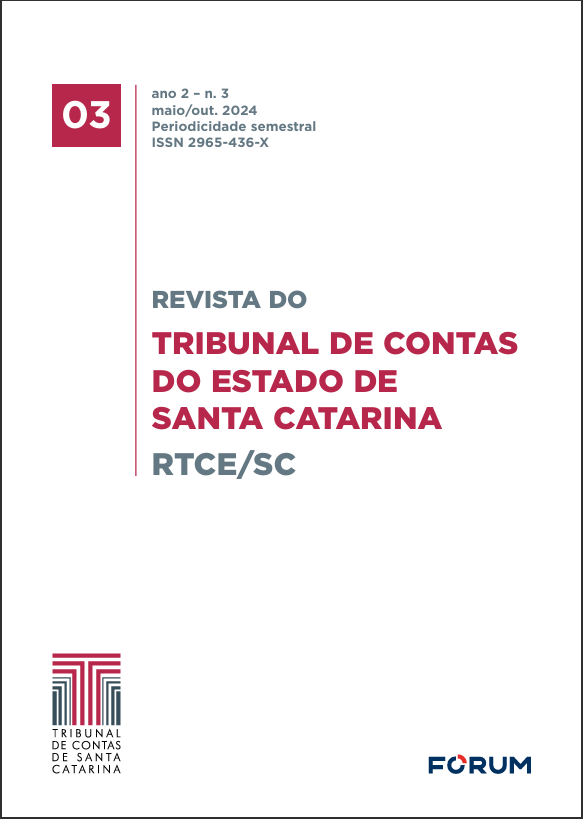
Copyright (c) 2026 Revista do Tribunal de Contas do Estado de Santa Catarina

Este trabalho está licenciado sob uma licença Creative Commons Attribution-NonCommercial-ShareAlike 4.0 International License.